No, not the children's horror book, but the odd phenomena that happens to your skin and hairs when you feel cold or get a little scared. It's a weird thing, and I want to explain it to myself, and I guess the benefit will be that it will be explained to you. If you so choose to read. Actually, I have goosebumps now because my office is freezing. Also my nipples are hard. But TMI. I'll go over what I think I know, and we'll confirm by other sources. It's going to be a fun trip.
So from what I know, goosebumps are a reflex/reaction that we took from our ancestors, who were supposedly super hairy because we hadn't invented jackets and sweaters and socks... and underwear yet. When cavemen and cavewomen got cold, their body hair automatically stood up, creating a fluffy layer of warmth. Likewise when we’re cold, the muscles around the hair follicles contract. But since we don’t have much body hair, all we see are the goose bumps on our skin. That's pretty much what I know, and I think that's really all we need to know. But let's get down to the nitty gritty.
Goose bumps are messages from the brain to the skin to react to the animal oriented phenomena of fight or flight. Porcupine raising its quills on seeing a threat is a good example to understand goose bumps and their nature. Since human bodies cannot differentiate between real and imaginary conditions, goose bumps can be a reflex to a physical condition or a reaction to a psychological condition. Goosebumps are directly related to the adrenaline rush that flows through the body. Adrenaline rush can be triggered by fear or emotional reactions. Emotional reactions can be positive or negative, powered by intense ‘stress’ to induce the emotional welling up to trigger goose bumps.
Why do we call it goose bumps? Skins of geese or chickens have bumps at the place where feather is attached to the skin. Each spot on the human skin has a bump similar to the goose bump, and this connection must have given this phenomenon its name.
Scientifically, goose bumps are called Piloerections. Piloerections are emotion based autonomic reflex reactions routed through the limbic system. Piloerections are similar to blushing or feeling butterflies in the stomach. Limbic system controls primitive drives of hunger, sex, fear, anger and aggression. Limbic system anatomically has thalamus, a major structure in control of the sensory inputs. Medial forebrain bundle and the hypothalamus play a major role in the invocation and mediation of the autonomic reflexes.
Goose bumps have been observed on head or scalp on scary occasions but goose bumps on a face requires well formed arrector pili muscles. Every arrector pili muscle does not have hair attached to them. Arrector pili with hair are found in areas with thick hair. Human facial hairs are extremely tiny and thin, so goose bumps on the face are rare.
That's all for now.
ta ta kids
PS
My PC at work has been acting up when it comes to blogspot as of late, but it seems it's been working well now.
Showing posts with label facts. Show all posts
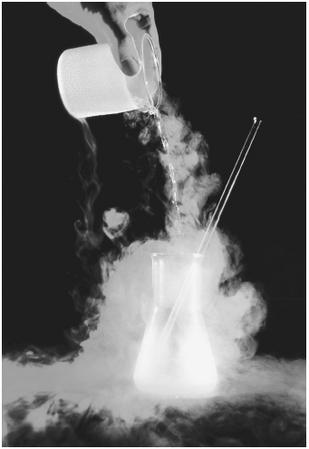
I'm gonna start off with LN2 and then do some comparison with LAr if I can drum up anything useful. So Nitrogen in itself is a pure element. It's got a pretty high boiling point, which is why the most common way we see it is right in front of our face... and everyone else's face too. That is, pure nitrogen occurs as a gas and makes up about 78% of our atmosphere. Both liquid and gas forms are clear and odorless, but LN2 is dangerous as it experiences some extremely cold properties. Without getting into too much detail, the way we make LN2 is a process known as condensation, and I know you've probably heard of it. Basically, an air compressor takes air from the atmosphere and well... compresses it. So much so that eventually molecules are forced together so close that weak bonds start to occur among them. When enough of these bonds form, liquid droplets form.
LN2 is used in a lot of ways, but the COOLEST (cwutididthar) way I ever experienced was to make ice cream. There are a lot of LN2 ice cream stores popping around in the world, and if you can find one, by all means take advantage. It may not be the best ice cream you've ever had, but the experience that goes along with it is worth it.
Liquid Ar (LAr) is different only in a few ways. First off, it only makes up about 1% of our atmosphere. In the thermal lab here, we use LAr for its inert properties, LN2 is regarded as an "inert gas" but in actuality can react with some metals at high temperatures. LAr is purely inert and will not react with anything at all (although there are extreme cases where it will bond with flourine). We can store both liquids in cryogenic containers or in large Dewars diesgined to store LN2 and LAr. Like most things, LN2 becomes cheaper as you order more (about 50 cents a liter). Obviously since Argon is rare, it isn't as cheap.
Ever wonder what would happen if you came into contact with LN2? Well, anythiing more than a second could probably do some damage. It'll feel like you got burned with a blow torch, and then you get frostbite. If one were to actually go so far as to dip their finger into a container of LN2, ther results aren't really that shocking. You'd freeze it. Although since you've got living cells in your skin, when frozen you're finger will expand a little bit and kill the cell walls surrounding it. It'll disrupt blood flow and may cause gangrene (you might want to look that one up).
That's really all the information I could think of for now. This was fun.
ta ta kids
Subscribe to:
Posts (Atom)